
The easiest way to get to Mount Longonot National Park is by road from Nairobi using the Nairobi–Nakuru highway, then turning off near Longonot toward the Mount Longonot National Park gate. Kenya Wildlife Service states that Mount Longonot National Park is accessible by road from Nairobi, about 90 km on the Nairobi–Nakuru highway.
Most visitors use one of four transport options:
| Transport option | Best for | Main route | Main advantage | Main drawback |
|---|---|---|---|---|
| Self-drive | Nairobi residents, groups, flexible travelers | Nairobi → Mai Mahiu / Longonot → park gate | Flexible timing and easiest return | Driver must manage traffic and fatigue after hike |
| Private transfer or tour | Tourists, families, first-time visitors | Hotel / airport pickup → park gate | Smoothest and safest logistics | More expensive |
| Matatu and boda/taxi | Budget travelers | Nairobi CBD → Naivasha/Longonot junction → gate | Cheapest independent option | Less predictable timing and return transport |
| Train plus taxi | Weekend experimenters | Nairobi Terminus → Mai Mahiu/Naivasha/Suswa route → taxi | Scenic but schedule-dependent | Not the most direct hiking option |
The most reliable Mount Longonot day-trip plan is to leave Nairobi early, reach the gate between 7:00 AM and 9:00 AM, hike before the midday heat, then return through Naivasha, Mai Mahiu, or the Great Rift Valley viewpoint depending on your itinerary.
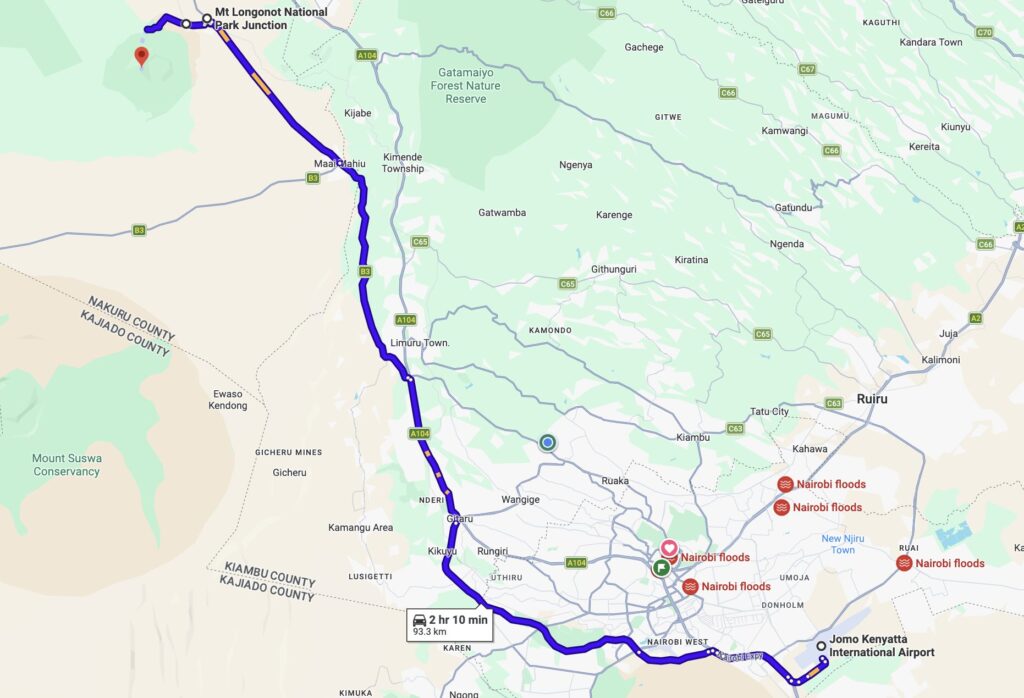
Where is Mount Longonot Located?
Mount Longonot is located in Kenya’s Great Rift Valley, near Naivasha, northwest of Nairobi. The mountain sits inside Mount Longonot National Park and is accessed by road through the Nairobi–Nakuru Highway. According to Google Maps estimates, the park is about 74.1 km from Nairobi CBD and about 93 km from JKIA Airport, while the official Kenya Wildlife Service Mount Longonot page places it approximately 90 km from Nairobi City by the Nairobi–Nakuru highway.
what is the best way to get to Mount Longonot?
The best way to get to Mount Longonot is by private car, self-drive, or organized day trip from Nairobi, leaving early in the morning and driving northwest toward the Nairobi–Nakuru highway before turning toward the Mount Longonot National Park gate. Budget travelers can use a Naivasha-bound matatu from Nairobi and connect from Longonot town or Longonot Junction to the park gate by boda boda or taxi.
| Transport option | Best for | Main advantage | Main limitation |
|---|---|---|---|
| Self-drive | Nairobi residents, confident drivers, small groups | Flexible timing and route control | Driver may be tired after the hike |
| Private transfer | Tourists, families, airport pickups, first-time visitors | Easiest and most reliable | Costs more than public transport |
| Guided day tour | Visitors who want transport and hiking logistics handled | Smoothest visitor experience | Less flexible than self-drive |
| Matatu plus boda/taxi | Budget travelers | Cheapest independent option | Unpredictable return logistics |
| Naivasha taxi | Visitors already staying in Naivasha | Short and convenient local transfer | Requires separate arrangement |
For most visitors coming from Nairobi, Mount Longonot should be treated as a full-day hiking trip, not a quick half-day stop. From Naivasha, it can work as a half-day activity because the access distance is much shorter.
How far is Mount Longonot from Nairobi?
Mount Longonot National Park is about 74.1 km from Nairobi CBD by Google Maps estimates and about 90 km from Nairobi City according to the official Kenya Wildlife Service Mount Longonot page. The park is reached by road through the Nairobi–Nakuru Highway, with the final approach leading toward the Mount Longonot National Park gate near Naivasha in the Great Rift Valley.
In normal travel planning, visitors should allow about 1.5 to 2.5 hours from Nairobi to the park gate depending on departure point, traffic, roadworks, weather, and stops along the Rift Valley escarpment. Westlands and Waiyaki Way-side pickups are usually more direct than JKIA or eastern Nairobi pickups because they are already closer to the main road out toward Naivasha.
| Starting point | Practical planning estimate | Comment |
|---|---|---|
| Nairobi CBD | 2 to 2.5 hours | Allow extra time for city traffic |
| Westlands | 1.5 to 2 hours | One of the easier Nairobi exits |
| Karen | 2 to 2.5 hours | Route depends heavily on traffic |
| JKIA | 2.5 to 3 hours | Cross-city or bypass routing needed |
| Naivasha | 30 to 45 minutes | Best base for a relaxed hike |
| Nakuru | 1.5 to 2 hours | Possible but less common than Nairobi or Naivasha |
What is the best route from Nairobi to Mount Longonot?
The best route from Nairobi to Mount Longonot is usually:
Nairobi → Waiyaki Way / Nairobi–Nakuru highway → Great Rift Valley escarpment → Mai Mahiu / Longonot area → Mount Longonot National Park gate.
This route follows the main Nairobi–Nakuru road corridor identified by KWS as the road access route to Mount Longonot.
The route decision is usually less important than the departure time. The road can be straightforward early in the morning, but Nairobi traffic, escarpment congestion, rain, and weekend day-trip traffic can stretch the journey. For hikers, a one-hour delay matters because the mountain becomes hotter and more tiring later in the day.
Best departure time from Nairobi
Leave Nairobi between 5:30 AM and 6:30 AM if you want a comfortable hiking day. This departure window helps you reach the gate early, begin the climb before the strongest heat, and still have enough time for the crater rim, descent, lunch, and return drive.
A later departure can still work, but it changes the quality of the day. Leaving Nairobi after 8:00 AM often means starting the hike late, climbing in stronger sun, and returning during heavier traffic.
Can you self-drive to Mount Longonot?
Yes. You can self-drive from Nairobi, Naivasha, Nakuru, or nearby towns to the Mount Longonot National Park gate. Self-drive is one of the best options for Nairobi residents and visitors who have a reliable car, a confident driver, and enough flexibility to manage the return journey after the hike.
A standard car is usually sufficient in dry conditions for reaching the gate, because the main journey uses the Nairobi–Nakuru highway. The final access road toward the park gate is the part where visitors should drive more carefully, especially after heavy rain.
Do you need a 4×4 for Mount Longonot?
You usually do not need a 4×4 just to reach the Mount Longonot gate. A normal car can often manage the access road in dry weather. A 4×4 or higher-clearance vehicle is more useful during rainy periods, if the access road is rough, or if you are combining the hike with other Rift Valley routes.
Self-drive checklist
- Use Mount Longonot National Park gate as your navigation target, not just Mount Longonot.
- Leave Nairobi early enough to avoid traffic and heat.
- Carry enough drinking water before arriving at the gate.
- Check fuel before leaving Nairobi or Naivasha.
- Avoid a late hike because the park is a mountain trail, not a short viewpoint stop.
- Be honest about driver fatigue after the descent.
Self-driving gives freedom, but the driver must still be fit enough to drive safely after several hours of hiking.
How do you get to Mount Longonot by matatu?
To get to Mount Longonot by matatu, board a Naivasha-bound matatu or shuttle from Nairobi, ask to be dropped at Longonot Junction, Longonot town, or the nearest practical stop for Mount Longonot, then take a boda boda or taxi to the park gate.
Public transport is the cheapest way to reach Mount Longonot, but it is not the smoothest. The matatu normally gets you close to Longonot, not directly to the trailhead. The final connection to the gate must be arranged locally.
Nairobi to Mount Longonot by public transport
| Step | What to do | Important note |
|---|---|---|
| 1 | Go to a Nairobi CBD stage with Naivasha-bound vehicles | Ask clearly for Naivasha via the Longonot / Mai Mahiu route |
| 2 | Tell the conductor you are going to Mount Longonot | Confirm the drop-off point before paying |
| 3 | Alight near Longonot | Do not assume the matatu enters the park road |
| 4 | Take a boda boda or taxi to the gate | Agree on the fare before starting |
| 5 | Pay park entry digitally | KWS lists payment through eCitizen via M-Pesa or Visa card |
| 6 | Arrange return transport before hiking | The return connection is the most common weak point |
Is public transport recommended?
Public transport is recommended for budget travelers who are familiar with Kenyan matatus, comfortable with local transfers, and not under time pressure. It is less suitable for families, first-time international visitors, hikers with heavy bags, or anyone who wants a guaranteed return schedule.
The main risk is not getting there. The main risk is finishing the hike tired and then having to negotiate transport from the gate back to the main road.
Where do you board a matatu to Mount Longonot in Nairobi?
You normally board a Naivasha-bound matatu or shuttle from Nairobi CBD transport areas used by Rift Valley vehicles. Ask for a vehicle going toward Naivasha, and confirm that it can drop you near Longonot before you board.
Use the destination language carefully. Do not only say “Mount Longonot” and assume the conductor understands you want the park gate. Say:
I am going to Mount Longonot National Park. Can you drop me at Longonot Junction or the nearest point for the park gate?
That sentence reduces confusion and makes the final connection easier.
How do you get from Longonot town to Mount Longonot gate?
From Longonot town or Longonot Junction, take a boda boda, taxi, or local vehicle to the Mount Longonot National Park gate. This short final transfer is important because walking from the main road to the gate adds unnecessary distance before a demanding hike.
Agree on the fare before starting, and ask the rider or driver about return arrangements. If using a boda boda, consider taking the rider’s phone number so you can call after the hike.
How do you get to Mount Longonot from Naivasha?
From Naivasha, Mount Longonot is easiest by taxi, hotel transfer, private car, or local matatu connection toward Longonot followed by boda boda to the gate. Naivasha is the best base for visitors who want a less rushed Mount Longonot hike because the drive is much shorter than coming from Nairobi.
| Naivasha transport option | Best for | Why it works |
|---|---|---|
| Taxi | Most visitors | Direct, reliable, and easy to arrange |
| Hotel transfer | Lodge and resort guests | Convenient if staying around Lake Naivasha |
| Private car | Self-drive visitors | Flexible and simple |
| Matatu plus boda | Budget travelers | Cheapest but less predictable |
| Organized local tour | Groups | Good for combining with lake activities |
Naivasha is also the better base if you want to combine Mount Longonot with Lake Naivasha, Crescent Island, Hell’s Gate, or a relaxed overnight itinerary.
How do you get to Mount Longonot from JKIA?
From JKIA, the best way to get to Mount Longonot is by private transfer or private tour vehicle. JKIA sits on the eastern side of Nairobi, while Mount Longonot lies northwest of the city toward the Rift Valley, so the journey usually requires crossing or bypassing Nairobi before joining the Nairobi–Nakuru route.
A Mount Longonot day trip from JKIA is possible, but it needs a full-day window. It is not a safe choice for a short layover because the drive, hike, descent, return journey, and airport security buffer can easily fill the day.
JKIA to Mount Longonot planning rule
Allow:
- 2.5 to 3 hours from JKIA to the park gate
- 3 to 6 hours for the hike
- 2.5 to 3 hours to return to JKIA
- extra time for traffic, meals, changing clothes, luggage, and airport procedures
For short Nairobi layovers, Nairobi National Park is usually more realistic. For a full outdoor hiking day, Mount Longonot is a strong choice.
How do you get to Mount Longonot from Westlands?
From Westlands, drive or transfer west out of Nairobi toward Waiyaki Way and the Nairobi–Nakuru highway, then continue toward the Rift Valley escarpment and Longonot. Westlands is one of the better Nairobi starting points for Mount Longonot because it sits closer to the road corridor leading out toward Naivasha.
A private car, self-drive, or organized transfer is usually better than matatu from Westlands because public transport often requires first going into Nairobi CBD or connecting to a Naivasha stage.
How do you get to Mount Longonot from Karen?
From Karen, the best route depends on traffic. Many drivers connect through bypass roads or western Nairobi routes to reach the Nairobi–Nakuru corridor, then continue toward Longonot and the park gate.
Karen is workable for Mount Longonot, but it is not as direct as Westlands. Visitors staying in Karen should leave early and check traffic before choosing the exact route. A private transfer is usually easier than public transport because it avoids cross-city stage connections.
How do you get to Mount Longonot by matatu?
To get to Mount Longonot by matatu, take a Naivasha-bound matatu or shuttle from Nairobi CBD, preferably one using the Mai Mahiu route, and ask to be dropped at Longonot Junction or Longonot town/centre. From there, use a boda boda, taxi, or local transfer to the Mount Longonot National Park gate. Independent public-transport guides commonly describe the route as Nairobi CBD or River Road/Railways area to Naivasha via Mai Mahiu, then alighting at Longonot Junction and taking a boda boda or taxi to the gate.
Public transport route
| Step | What to do | Visitor advice |
|---|---|---|
| 1 | Go to Nairobi CBD matatu/shuttle area for Naivasha vehicles | Ask specifically for Naivasha via Mai Mahiu |
| 2 | Tell the conductor you are going to Mount Longonot | Repeat that you want Longonot Junction or Longonot town |
| 3 | Alight near Longonot | Do not sleep through the stop; ask before departure |
| 4 | Take boda boda or taxi to the park gate | Agree on fare before starting |
| 5 | Pay park entry through eCitizen/KWSPay | KWS lists eCitizen payment by M-Pesa or card |
KWS confirms that Mount Longonot park entry payment is made through eCitizen/KWSPay, with M-Pesa and Visa card options listed.
Is public transport a good option?
Public transport is good for budget travelers who are comfortable with Kenyan matatus, flexible timing, and local boda boda transfers. It is less ideal for families with children, visitors with luggage, first-time international travelers, or hikers who want a guaranteed return schedule after a tiring climb.
Where do you board a matatu to Mount Longonot in Nairobi?
Most travelers look for Naivasha-bound matatus or shuttles in the Nairobi CBD transport areas, especially around River Road, Nyamakima, OTC, Railways, or nearby stages used by Naivasha vehicles. Public transport guides commonly mention Nairobi CBD, River Road, Railways Station, OTC, and Nyamakima as practical starting points for Naivasha or Longonot-bound travel.
The key is not the stage name alone. The key is the route. You want a vehicle heading toward Naivasha via Mai Mahiu, not one going to Narok, Bomet, or a different Rift Valley route unless you understand where you will connect.
How much does it cost to get to Mount Longonot?
The cheapest way to get to Mount Longonot from Nairobi is by public transport, which usually costs about KES 300 to KES 500 for the Nairobi–Longonot matatu or shuttle, depending on the vehicle, stage, day of travel, and demand. From Longonot town or Longonot Junction, you may still need a boda boda or local taxi to reach the Mount Longonot National Park gate, so budget a little extra for the final connection. Once you get to Mount Longonot entry gate, you’ll need an entry ticket which you can purchase online. For details on the cost of entry ticket and how to purchase it, read this guide on Mount Longonot entrance fee guide.
What time should you arrive at Mount Longonot?
Arrive at Mount Longonot between 7:00 AM and 9:00 AM if you are coming from Nairobi and planning to hike. This gives you enough daylight, cooler conditions, and a safer margin for the crater rim and descent.
KWS lists Mount Longonot as a terrain-based hiking destination with no internal roads, so visitors should plan the day around walking time rather than vehicle-based sightseeing.
Recommended Nairobi day-trip schedule
| Time | Activity |
|---|---|
| 5:30 AM | Leave Nairobi |
| 7:30 AM | Arrive near Mount Longonot gate |
| 7:45 AM | Complete entry/payment checks |
| 8:00 AM | Start hiking |
| 10:00 AM | Reach crater rim depending on pace |
| 10:30 AM–1:00 PM | Optional crater rim circuit |
| 1:00 PM–2:00 PM | Descend and rest |
| 2:00 PM–3:00 PM | Lunch near Longonot or Naivasha |
| 3:00 PM–5:30 PM | Return to Nairobi |
This schedule works because it gives priority to the hike before any add-on attraction. If you want Lake Naivasha afterward, keep the hike efficient and avoid starting late.
4 Options of getting to Mount Longonot:
🚗 Option 1: Self-Drive (Most Popular)
Distance: Approximately 75 km
Driving Time: ~1½ hours from Nairobi
Route Guide:
- From Nairobi City Center:
- Take Waiyaki Way (A104) heading west towards Naivasha.
- Pass through Limuru and descend into the Great Rift Valley via the Mai Mahiu road.
- Stop at the Great Rift Valley Viewpoint for breathtaking photos (~1 hr from Nairobi).
- Continue past Mai Mahiu town for another ~20 minutes.
- Turn left at the clearly marked sign for Mount Longonot National Park gate.
- Road Condition:
- Excellent tarmac highway (A104) from Nairobi to park entrance turnoff.
- Short, well-maintained gravel/dirt road (~3 km) from highway to park gate; accessible by standard vehicles.
🛣️ Pro Tip:
Leave Nairobi early (around 6–7 AM) to avoid heavy truck traffic and enjoy cooler temperatures for your hike.
🚌 Option 2: Public Transport (Budget-Friendly)
Step-by-Step:
- From Nairobi (CBD):
- Take a matatu (public minibus) or shuttle from Nairobi CBD (River Road area) or from Railways Station going towards Naivasha via Mai Mahiu.
- Fare: Approximately KES 300–500 per person.
- Travel time: ~1½–2 hours.
- Alight at the Mount Longonot Junction (mention clearly to the conductor).
- Landmark: Large signage and junction clearly marked.
- From junction, park gate is about 3 km along the dirt road.
- At junction:
- Hire local boda boda (motorbike taxi) for ~KES 100–200.
- Or walk (~30–40 minutes easy walk).
- Take a matatu (public minibus) or shuttle from Nairobi CBD (River Road area) or from Railways Station going towards Naivasha via Mai Mahiu.
🚦 Pro Tip:
Confirm fare clearly before boarding and alighting points with the conductor. Matatus departing before 8 AM from Nairobi are most reliable.
🚐 Option 3: Organized Tours & Private Transfers
- Ideal for groups, first-time visitors, or comfort seekers.
- Numerous Nairobi-based tour companies offer:
- Transport (minivan or Land Cruiser).
- Professional driver/guides.
- Park entry fees included.
- Options to combine Longonot with Hell’s Gate or Lake Naivasha.
Average Tour Costs:
| Tour Type | Average Cost (per person) |
|---|---|
| Day tour (group/shared) | KES 3,500–6,000 (~USD 25–45) |
| Private day tour to Mt Longonot | KES 10,000–20,000 (~USD 70–140) |
📌 Recommended Tour Providers:
- Bonfire Adventures
- Expeditions Maasai Safaris
- Perfect Wilderness Tours
📆 Pro Tip:
Booking online or through your hotel/lodge in Nairobi simplifies arrangements and ensures reliable, professional service.
🚖 Option 4: Taxi & Ride-Hailing Services
- Services such as Uber, Bolt, and Little Cabs available from Nairobi.
- Cost estimate: KES 4,500–6,500 (~USD 30–45) one-way, depending on availability and demand.
- Travel time: ~1½ hours each way.
📱 Pro Tip:
Pre-book your return trip or negotiate a full-day rate with the driver to avoid being stranded at the park, as ride-hailing services might not be easily accessible for return journeys.
🛑 Essential Stops Along the Route
Enhance your drive by stopping at:
- Great Rift Valley Viewpoint: Iconic panoramic views, curio shopping.
- Mai Mahiu Italian Church: Historic landmark built by Italian POWs during WWII.
- Mai Mahiu Town: Fuel, restaurants, supermarkets for snacks & water.
🛎️ Where to Stay Nearby
If planning an early hike or staying late, consider accommodation in nearby Naivasha (~20 min from Longonot):
- Budget: Camp Carnelley’s, Fisherman’s Camp
- Mid-Range: Lake Naivasha Resort, Naivasha Kongoni Lodge
- Luxury: Enashipai Resort & Spa, Lake Naivasha Sopa Lodge
✅ Travel & Preparation Checklist
- Fuel your car fully in Nairobi or Mai Mahiu.
- Carry cash for park fees (KES/USD), snacks, and any emergencies.
- Pack water, sunscreen, hats, hiking shoes, and layered clothing (weather changes quickly at altitude).
- Charge phones fully—signal along the highway is good, limited in the park.
📌 FAQs & Important Tips
- Park Gate Hours: 6:00 AM–6:00 PM daily.
- Last Entry: Typically 4:00 PM.
- Safety: Roads and the park are safe during daylight hours; avoid driving after dark due to limited street lighting.